— By Chris Gonzales, Freelance Writer, New York Sea Grant
Contact:
Lane Smith, Research Program Coordinator, NYSG, E: lane.smith@stonybrook.edu, P: (631) 632-9780
Stony Brook, NY, January 6, 2025 - Here are over a dozen summaries of completed studies (in some cases with related published journal articles) based on New York Sea Grant–funded research projects ...
Coastal Resilience
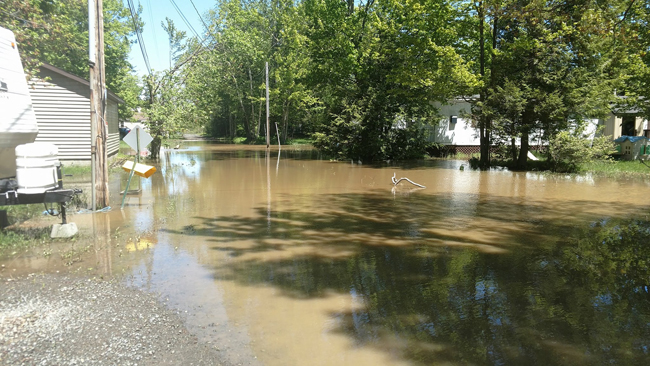
Flooding in the town of New Haven (Oswego County, NY) from Lake Ontario in 2017. Credit: NYSG’s 2017 Coastal Flooding Survey Project
Flood resilience on Lake Ontario
Scott Steinschneider, Cornell University
Scientists are using mathematical modeling to determine and understand flood risk for Lake Ontario and, by extension, the entire Great Lakes shoreline. This approach can support coastal flood risk assessments now and in the future under climate change. Researchers are also working to understand barriers to local flood risk adaptation along the shoreline to improve programs meant to support community flood risk planning efforts.
Contact: Scott Steinschneider (ss3378@cornell.edu)
Water Quality & Health Concerns
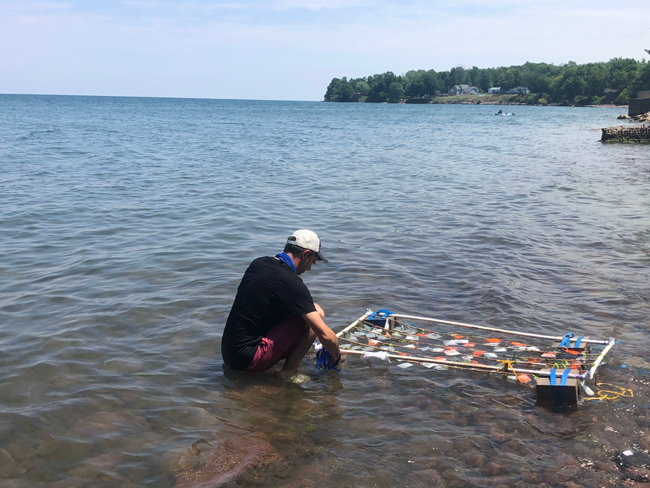
Researcher Steven Day secures a benthic frame in Lake Ontario as part of one of New York Sea Grant’s collaborative 'ecosystem impacts of microplastic pollution' projects with RIT. Credit: Christy Tyler
Movement of microplastics in Lake Erie and Lake Ontario
Juliette Daily, Rochester Institute of Technology
Anna Christina Tyler, Rochester Institute of Technology
Matthew Hoffman, Rochester Institute of Technology
Studies have shown that an excess of plastic is finding its way into the Great Lakes and the oceans. However, samples of water near the surface find far less plastic than would be expected. Scientists now believe that in many cases, plastic becomes “biofouled,” that is, covered with organic matter, weighing it down until it sinks to the bottom. This study attempted to look in fine detail at how far these plastic particles may be traveling, and under what conditions they become deposited at the bottom or on the shore. They found a majority of particles becomes deposited, consistent with what would be caused by biofouling. Biofouling also causes particles to become spread along the lake floor, instead of concentrated at the shorelines. The questions raised by this research include what exactly are the plastic accumulation rates in the sediment and the risk plastics may pose for organisms and ecosystems at the bottom of the lakes.
Contact: Juliette Daily (jmd2924@rit.edu)
When disposable face masks and gloves become pollution in the water
Kirstina Chomiak, Rochester Institute of Technology
Nathan Eddingsaas, Rochester Institute of Technology
Anna Christina Tyler, Rochester Institute of Technology
In laboratory experiments, scientists tested whether disposable face masks and gloves, a staple of COVID-19 illness prevention, caused harm to a type of worm found in the muddy soil at the bottom of lakes and streams. If these gloves and masks are not disposed of properly, they find their way into the environment where aquatic organisms will come into contact with them. Scientists chose to study Lumbriculus variegatus, a key player in the soft-bottom ecosystems of lakes and streams. They did find evidence of harm. In fact, the plastics were toxic to the worms, and the gloves, which contain many chemical additives, had a larger detrimental effect. An important implication of their work is that because plastic products are composed of many different materials and chemicals, each type will have a different impact on the environment. The researchers add that the materials disrupt ecosystem function and have impacts on the biogeochemistry of the soil.
Contact: Anna Christina Tyler (actsbi@rit.edu)
Fisheries: Shellfish Studies in NY’s Marine Waters
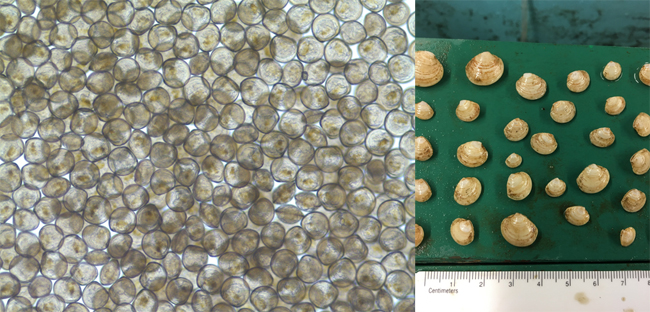
(At left) Two-day old hard clam larvae. These happen to be in the control treatment of an ocean acidification experiment. Credit: Bassem Allam, Stonybrook University; (at right) 22-month-old clams, raised since fertilization under ocean acidification conditions. Credit: Caroline Schwaner
Clams, genetics, and acidified environments
Caroline Schwaner, Stony Brook University
Bassem Allam, Stony Brook University
Northern quahog clams (Mercenaria mercenaria) is threatened by ocean acidification (OA), the harmful process caused by the excess absorption of carbon dioxide gas into the sea. However, this new study shows that these clams can increase their internal pH (reducing acidity) and increase their calcium levels. This shows they may have some adaptive ability in the face of OA.
Contact: Bassem Allam (Bassem.Allam@stonybrook.edu)
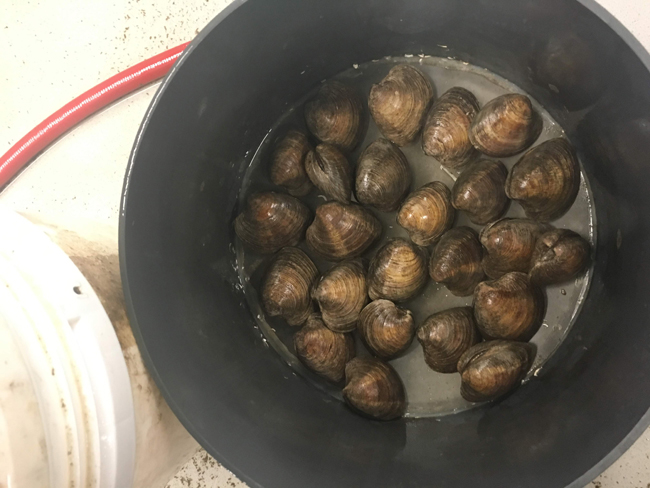
These clams are being held in an experimental chamber to assess the effect of ocean acidification on biomineralization and immunity. Credit: Caroline Schwaner
Hard clam (Northern quahog) resilience to ocean acidification
Caroline Schwaner, Stony Brook University
Sarah Farhat, Stony Brook University
Michelle Barbosa, Stony Brook University
Bassem Allam, Stony Brook University
Changes in the carbonate chemistry of the ocean due to OA can harm economically and ecologically important species such as the northern quahog (Mercenaria mercenaria). Scientists are trying to understand how these creatures might adapt to such swift changes in the environment. Their genetic studies showed significant shifts in gene expression among clams raised in acidified environments.
Contact: Bassem Allam (Bassem.Allam@stonybrook.edu)
Northern bay scallops, ocean warming, and dead zones
Stephen Tomasetti, Hamilton College
Christopher Gobler, Stony Brook University
This study investigated the effects of warming and hypoxia (lack of life-giving oxygen) on northern bay scallops - a population that experienced severe declines in 2019-2021, erasing previous gains made in recent decades. Scientists used satellite-based temperature records, field and lab experiments, and measures of scallop cardiac activity to assess their levels of thermal and hypoxic stress, and study helps us understand in more detail the additive effects of ocean acidification, warming, and hypoxia.
Contact: Christopher Gobler (Christopher.gobler@stonybrook.edu)
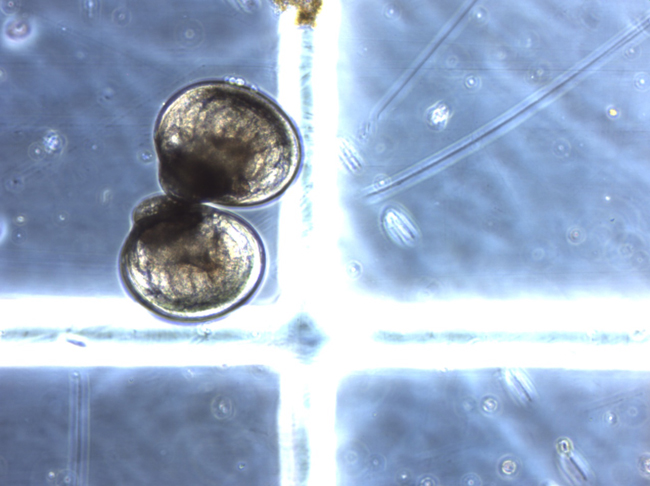
Triploid oyster larvae grown under ocean acidification conditions. ‘Triploid’ means they have a chromosomal number three times the monoploid number. Scientists are learning about how these clams can genetically adapt in order to protect themselves against disease and survive in tough ocean-acidified conditions. Credit: Caroline Schwaner
Genetics of crassostrea virginica (Eastern oyster)
Michelle Barbosa, Stony Brook University
Caroline Schwaner, Stony Brook University
Bassem Allam, Stony Brook University
Little is known about the acclimation of bivalves to ocean acidification (OA) conditions. In a lab experiment, larvae that started in harsh conditions and then were moved to normal conditions rebounded and recovered quickly, and their sizes were larger than those that remained in harsh conditions. This study indicates how extensive acclimation can be as a mode of resilience to OA. Scientists also are beginning to identify genes existing in the wild that can be selected for resistance to OA conditions.
Contact: Bassem Allam (Bassem.Allam@stonybrook.edu)
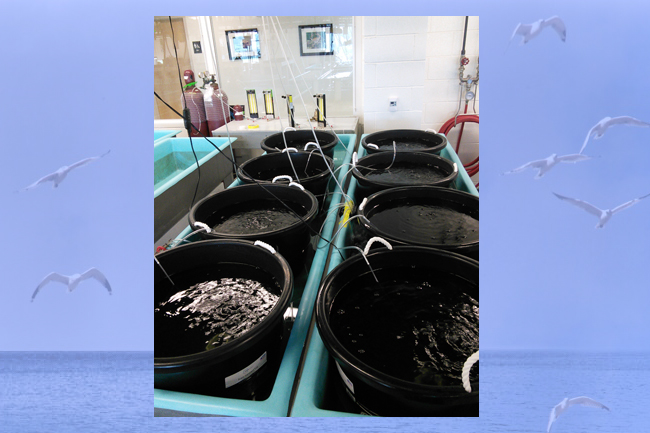
The experimental setup for an ocean acidification experiment. Credit: Bassem Allam
Genetics, oysters, and acidification
Caroline Schwaner, Stony Brook University
Bassem Allam, Stony Brook University
Scientists exposed oyster larvae to either experiment or control groups. In the experiment group, Ocean Acidification conditions were present. In the other, there were none. They found that a naturally occurring gene in the oyster helps them manage in OA conditions. While not the first discovery of this gene, it adds to the evidence about genes that can help oysters survive in OA conditions.
Contact: Bassem Allam (Bassem.Allam@stonybrook.edu)
Oyster aquaculture and the carbon cycle
Kate Liberti, University of Maine
Matt Gray, University of Maryland
Oysters are known to improve water quality by removing nitrogen from the water. However, to date their role in impacting surrounding carbonate chemistry has gotten little scientific attention. Shell building removes calcium and carbonate from the water, while breathing reduces the amount of carbonate available for more shell building, and so these processes can become self-limiting when oysters are grown in dense aggregations with little changeover of water. Scientists conducted their research in the Damariscotta River Estuary in Maine, a longtime locale for oyster farming that has experienced recent growth. Results show that currently, oysters have the ability to reduce aragonite saturation state, a measure of how easily shellfish can form shells, by 2 to 3%. When growing oysters, stocking density and the residence time of the system are important factors to consider, such that the oysters do not remove enough carbonate to become self-limiting or detrimental to other shell building organisms.
Contact: Kate Liberti, Matt Gray (kate.liberti@maine.edu, mgray@umces.edu)
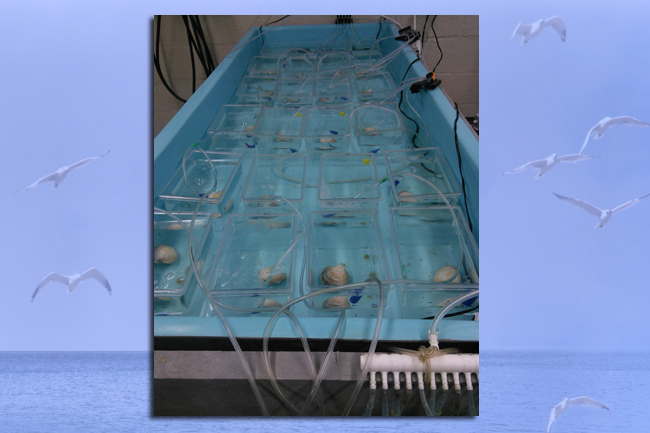
The experimental setup for a QPX (Mucochytrium quahogii) ecology experiment. Credit: Bassem Allam
Hard clam and QPX disease
Sabrina Geraci-Yee, Stony Brook University
Bassem Allam, Stony Brook University
Scientists made improvements to the most commonly available test for detecting the presence of QPX disease in hard clams, making made 19 significant changes which they say should enable it to be a more effective and efficient tool for disease monitoring in the hard clam.
Contact: Bassem Allam (Bassem.Allam@stonybrook.edu)
The cause of QPX, a disease of hard clams
Sabrina Geraci-Yee, Stony Brook University
Bassem Allam, Stony Brook University
Mucochytrium quahogii, a protozoan pathogen, causes QPX disease in hard clams, and this study aims to understand more about this pathogen and its relationship to its shellfish host. M. quahogii is broadly distributed in clams and the environment—in areas with and without a known history of QPX. There appears to be minimal risk of spreading QPX disease to new clam populations, as the pathogen is already present and does not cause disease without favorable conditions.
Contact: Bassem Allam (Bassem.Allam@stonybrook.edu)
QPX in environmental samples
Sabrina Geraci-Yee, Stony Brook University
Bassem Allam, Stony Brook University
An easy-to-use test to detect QPX disease would greatly aid in the detection and management of outbreaks. Scientists have been working on a solution. A new assay they developed works well and is reliable.
Contact: Bassem Allam (Bassem.Allam@stonybrook.edu)
Hard clam genome and immune function
Sarah Farhat, Stony Brook University
Bassem Allam, Stony Brook University
The hard clam Mercenaria mercenaria is a major shellfish species found along the Atlantic coast of North America, which is frequently used for commercial and ecological reasons. M. mercenaria has been introduced to other continents as a farmed seafood product or for environmental restoration, yet it has also suffered from diseases such as microbial infections or leukemia. Scientists are working to decode the hard clam genome to better understand things like the spread of cancer in shellfish and how these organisms adapt to changing ocean conditions, and this paper discusses how immune molecules supported by the hard clam genetic base can enable disease resistance.
Contact: Bassem Allam (Bassem.Allam@stonybrook.edu)
Genetics, immunity, and biomineralization in the hard clam
Caroline Schwaner, Stony Brook University
Sarah Farhat, Stony Brook University
John Haley, Stony Brook University
Emmanuelle Pales Espinosa, Stony Brook University
Bassem Allam, Stony Brook University
Bivalves such as the hard clam Mercenaria mercenaria have immune systems based on circulating hemocytes — cells that ingest foreign particles, bacteria, and dead or dying cells. The hemocytes are found in the hemolymph, a fluid that circulates inside the body of the invertebrate, like blood. This study looked at hemocytes in the extrapallial fluid, the space between the shell and the mantle of the clam, the site where the clam forms its shell, a process called biomineralization. This study looked at the genetics of the EPF, finding new clues about clam biomineralization and immunity that could protect these economically important species against disease.
Contact: Bassem Allam (Bassem.Allam@stonybrook.edu)
Fisheries: Other Studies in Great Lakes and Marine Waters
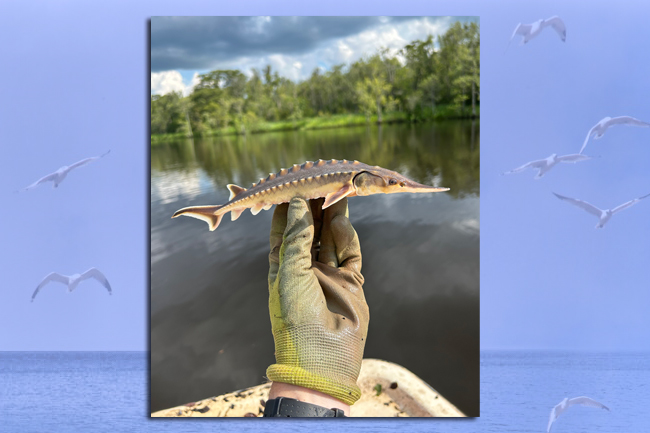
This is a juvenile Atlantic sturgeon from the Ogeechee River. In the Ogeechee River, there are two distinct populations of Atlantic sturgeon, one that spawns in the spring and one that spawns in the fall. Based on this fish's size and date of capture, it is most likely a spring-spawned juvenile. However, it has not yet been genetically analyzed and assigned to a particular population. Credit: Joseph Nolan, University of Georgia
Atlantic sturgeon in the Ogeechee River, Georgia
Isaac Wirgin, New York University School of Medicine
The Atlantic sturgeon (Acipenser oxyrinchus oxyrinchus) occurs in rivers and marine waters of the Atlantic Coast. This fish has shown widespread declines since the late 1990s and has been afforded conservation protection. Scientists used microsatellite analysis—a method of assessing DNA from creatures in the wild—drawing from 13 spawning rivers from Quebec, Canada to Georgia in the US. They identified two distinct clusters of juvenile Atlantic sturgeon in the Ogeechee River, Georgia, one that is migratory and one that is residential in the river. Understanding the population structure of this species will help with its management and conservation.
Contact: Isaac Wirgin (isaac.wirgin@nyumc.org)
Summer flounder genetics and population structure
Isaac Wirgin, New York University School of Medicine
Summer flounder (Paralichthys dentatus) is an important commercial and recreationally fished species, but in recent years researchers have debated their abundance and how much anglers should be permitted to catch. To help answer this question, researchers used a technique called DNA microsatellite analysis, a sensitive genetic approach to assess population differences using DNA samples from organisms. Their results showed that the summer flounder fishery is supported by one, or at most, two stocks. The authors believe that in the future a warming ocean could lead to a further split in this population, which could mean important implications for how the fishery is managed.
Contact: Isaac Wirgin (isaac.wirgin@nyumc.org)
More Info: New York Sea Grant
Established in 1966, the National Oceanic and Atmospheric Administration (NOAA)’s National Sea Grant College Program promotes the informed stewardship of coastal resources in 34 joint federal/state university-based programs in every U.S. coastal state (marine and Great Lakes) and Puerto Rico. The Sea Grant model has also inspired similar projects in the Pacific region, Korea and Indonesia.
Since 1971, New York Sea Grant (NYSG) has represented a statewide network of integrated research, education and extension services promoting coastal community economic vitality, environmental sustainability and citizen awareness and understanding about the State’s marine and Great Lakes resources.
NYSG historically leverages on average a 3 to 6-fold return on each invested federal dollar, annually. We benefit from this, as these resources are invested in Sea Grant staff and their work in communities right here in New York.
Through NYSG’s efforts, the combined talents of university scientists and extension specialists help develop and transfer science-based information to many coastal user groups—businesses and industries, federal, state and local government decision-makers and agency managers, educators, the media and the interested public.
New York Sea Grant, one of the largest of the state Sea Grant programs, is a cooperative program of the State University of New York (SUNY) and Cornell University. The program maintains Great Lakes offices at Cornell University, SUNY Buffalo, Rochester Institute of Technology, SUNY Oswego, the Wayne County Cooperative Extension office in Newark, and in Watertown. In the State's marine waters, NYSG has offices at Stony Brook University and with Cornell Cooperative Extension of Nassau County on Long Island, in Queens, at Brooklyn College, with Cornell Cooperative Extension in NYC, in Bronx, with Cornell Cooperative Extension of Ulster County in Kingston, and with Cornell Cooperative Extension of Westchester County in Elmsford.
For updates on Sea Grant activities: www.nyseagrant.org, follow us on social media (Facebook, Twitter/X, Instagram, Bluesky, LinkedIn, and YouTube). NYSG offers a free e-list sign up via www.nyseagrant.org/nycoastlines for its flagship publication, NY Coastlines/Currents, which it publishes 2-3 times a year.