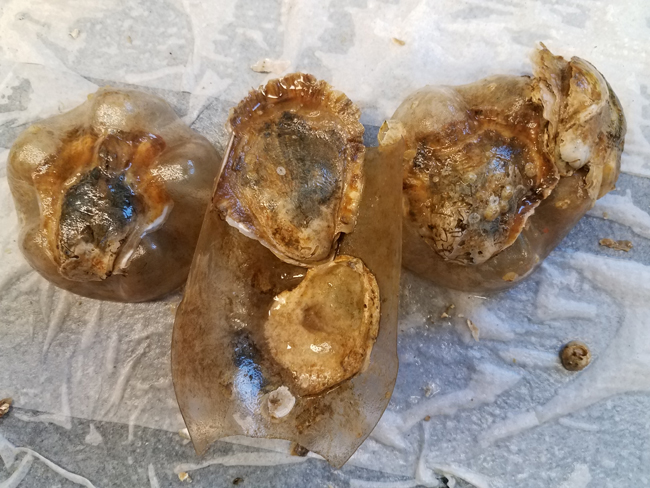
Oysters that have been reared on plastic. Credit: Laura Eierman
— By Chris Gonzales, Freelance Writer, New York Sea Grant
Contact:
Lane Smith, Research Program Coordinator, NYSG, E: lane.smith@stonybrook.edu, P: (631) 632-9780
New evidence points to the risk posed by plastic pollution in marine ecosystems
Cortland, NY, February 18, 2025 - In recent years, media awareness of the issue has been increasing. Whales entangled in plastic fishing gear. Sea turtles sickened from eating plastic bags. Shorebirds wandering on beaches, picking up and swallowing coin-sized plastic chips. Such images illustrate the dangers of plastic. Yet there are other less-visible, and more insidious, risks.
One creature that could suffer in the dice game is the eastern oyster, a key part of marine ecosystems. In estuaries like the Long Island Sound, the eastern oyster builds reefs that other fish live in. These reefs provide habitat for hundreds of species. These oysters also famously filter the water and make it clearer.
Yet scientists are learning plastic pollution may even undermine reproduction in some marine species, including the eastern oyster. A recent study found plastic pollution skewed the sex ratio of oysters from male to female.
“Long-term exposure to plastic debris, such as from water and soda bottles, alters the expression of genes that causes an oyster to develop either as a male or female,” said Laura Eierman, a scientist at SUNY Cortland, who recently published a paper on the topic1. “The result is more females than typically seen in one-year old oysters. Additionally, we found evidence that suggests reduced biomineralization of the shell, which could lead to slower growth or weaker shells. We also found evidence of a repressed immune response and increased stress.”
If plastic is both skewing populations female and reducing the rate of successful fertilization, oyster populations may have reduced reproduction overall.
In their paper, the authors point to the need to move society away from our plastic dependence, and particularly away from single-use plastics.
Scientific Findings
Sex determination in the eastern oyster is influenced both by genetics and by environmental factors. The latter includes things such as gregariousness (whether they live in groups) and temperature.
The authors hypothesized that exposure to a type of plastic called polyethylene terephthalate, or PET, would negatively impact growth and survival and would cause femininization of protandric oysters. In zoology, protandric means the organism has male sexual organs while young, and female organs later in life. This natural process happens through altered expression of genes involved in making sperm and eggs.
Scientists want to know what effects the chemical leachate of plastics (substances coming off of plastics) has on sex differentiation in this hermaphroditic oyster species.
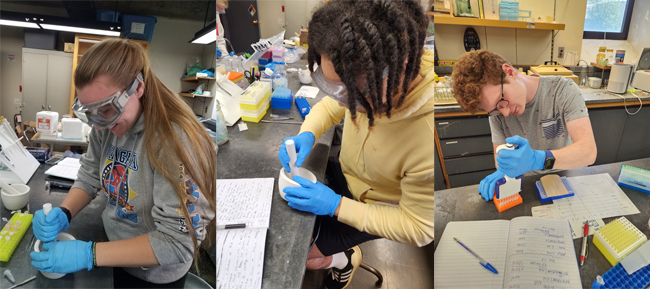
(at left) Undergraduate student Marissa Kordal (SUNY Cortland '22) grinds frozen oyster gill tissue during an RNA extraction; (in middle) Undergraduate student Keolani Savage (SUNY Cortland '26) grinds frozen oyster gill tissue during an RNA extraction. Keo completed this work as part of a Louis Stokes Alliance for Minority Participation summer fellowship; (at right) Undergraduate student Makiah Poli uses a multichannel micropipette to set up quantitative polymerase chain reaction (qPCR) experiments to measure changes in gene expression in oyster tissue from exposure to plastic pollution. Credit: Laura Eierman
The Experiment
The scientists obtained new plastic beverage bottles made of PET plastic, then cut them into pieces the approximate size and shape of oyster shells. They chose plastic bottles with the kind of concavity that oysters choose for settlement (landing sites where new oysters are grown). They went so far as to lightly sand the bottle chips to generate the appropriate texture that oysters like. They had three bags of plastic, three of oyster shell. They set them into a settlement tank in the St. Mary’s River in Maryland, a tributary of the Chesapeake Bay.
The bags were left for some time to allow the larvae to settle and metamorphose into spat—about three weeks. Spat were then reared in an aquaculture facility for three months.
The oysters were then sacrificed for scientific study. A piece of gonadal and gill tissue was collected from each oyster. Gonadal fluid was transferred to a microscope slide and observed for sex determination.
They selected candidate genes to study, including eight for gamete production and one “housekeeping” gene as a control. In genetics, housekeeping genes are widely expressed in all cells and conditions, carrying out basic organism maintenance. They can be similar across species.2
Results
“The proportion of oysters grown on plastic skewed significantly more female (44% female and 56% male) than those grown on shell (18% female and 82% male) (p < 0.001),” the authors wrote.
The scientists also took a close look at the mortality, growth, maturation, of first-year eastern oysters, focusing on three months and ten months post-settlement, using plastic as a settlement substrate.
After ruling out other potential mechanisms, the scientists believe that exposure to the plastic caused the shift. The authors do caution that their experiment had a small sample size, and that larger studies are needed in the future.
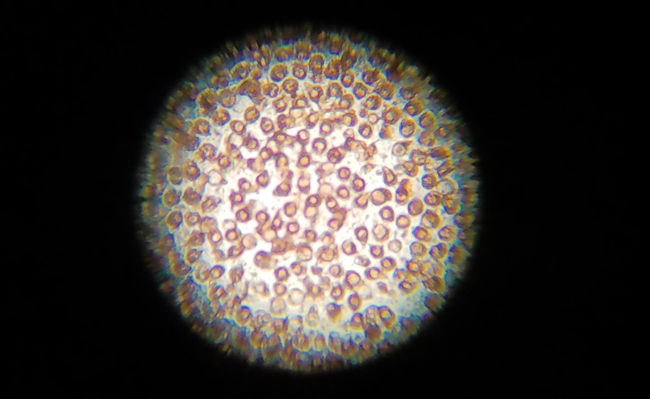
Oyster eggs through a microscope. Credit: Laura Eierman
Zoom In On Science
The scientists were trying to determine if exposure to plastic affected gene expression in oysters.
Their experiment had different groups: males and females, shell or plastic background, and by comparing gonadal or gill tissue.
The scientists were looking closely at segments of DNA referred to as “contigs.” This term derives from “contiguous,” and refers to an adjoining region of the genome.
By looking at the different numbers of contigs appearing in the different groups, they could see how the plastic-exposed oysters were expressing their genes, as opposed to the ones raised on shell.
They found the male oysters raised on plastic tended to have expression profiles similar to females, especially the females raised on shell.
Given the exposure to microplastic debris with presumable chemical leaching of xenoestrogens, this minimal differentiation by substrate or sex on gene expression within gill tissue follows expectations.
Interesting, New Hypotheses Emerge
These findings lead to new hypotheses. (1) plastic may induce the expression of oogenesis genes without leading to the formation of eggs in male oysters, (2) plastic may homogenize expression of genes in female and hermaphroditic oysters, compensating for individual variation in estrogen or other chemical cues, and (3) the overlap in the expression by males on plastic and females on shell may suggest candidate genes to explore as playing a role in the switch of gamete production from sperm to eggs. The scientists point out that future studies are needed.
In conclusion, this timely new research points to the potential hazards of marine plastic pollution. It also carries out some sophisticated analysis of gene expression and how it can shift in affected organisms. This research ultimately may help us protect the eastern oyster, a key species in oceans and estuaries up and down the US East Coast.
References
1 https://doi.org/10.1016/j.jembe.2021.151605 Accessed January 27, 2025
2 https://www.ncbi.nlm.nih.gov/pmc/articles/PMC9312424/ Retrieved February 13, 2023.
More Info: New York Sea Grant
Established in 1966, the National Oceanic and Atmospheric Administration (NOAA)’s National Sea Grant College Program promotes the informed stewardship of coastal resources in 34 joint federal/state university-based programs in every U.S. coastal state (marine and Great Lakes) and Puerto Rico. The Sea Grant model has also inspired similar projects in the Pacific region, Korea and Indonesia.
Since 1971, New York Sea Grant (NYSG) has represented a statewide network of integrated research, education and extension services promoting coastal community economic vitality, environmental sustainability and citizen awareness and understanding about the State’s marine and Great Lakes resources.
NYSG historically leverages on average a 3 to 6-fold return on each invested federal dollar, annually. We benefit from this, as these resources are invested in Sea Grant staff and their work in communities right here in New York.
Through NYSG’s efforts, the combined talents of university scientists and extension specialists help develop and transfer science-based information to many coastal user groups—businesses and industries, federal, state and local government decision-makers and agency managers, educators, the media and the interested public.
New York Sea Grant, one of the largest of the state Sea Grant programs, is a cooperative program of the State University of New York (SUNY) and Cornell University. The program maintains Great Lakes offices at Cornell University, SUNY Buffalo, Rochester Institute of Technology, SUNY Oswego, the Wayne County Cooperative Extension office in Newark, and in Watertown. In the State's marine waters, NYSG has offices at Stony Brook University and with Cornell Cooperative Extension of Nassau County on Long Island, in Queens, at Brooklyn College, with Cornell Cooperative Extension in NYC, in Bronx, with Cornell Cooperative Extension of Ulster County in Kingston, and with Cornell Cooperative Extension of Westchester County in Elmsford.
For updates on Sea Grant activities: www.nyseagrant.org, follow us on social media (Facebook, Twitter/X, Instagram, Bluesky, LinkedIn, and YouTube). NYSG offers a free e-list sign up via www.nyseagrant.org/nycoastlines for its flagship publication, NY Coastlines/Currents, which it publishes 2-3 times a year.