— By Sumayyah Uddin, NYSG's Science Writer
Contact:
Kathy Bunting-Howarth, NYSG's Associate Director, E: keb264@cornell.edu, P: 607-255-2832
Stony Brook, NY, November 29, 2025 - This past summer, New York Sea Grant (NYSG) provided eight students with the unique opportunity to work with scientists, community groups and government agencies through the 2025 Community Engaged Internship (CEI). Fellows gained hands-on work experience in their fields of interest, engaging with stakeholders and the public while they worked on projects with their mentors and NYSG partners.

Aileigh Ray spent her summer working at the H. Lee White Maritime Museum at Oswego, where she created her own exhibit on Lake Ontario recreation and tourism, provided lighthouse tours, and assisted with local events.
Aileigh Ray is a Fall 2025 senior at SUNY Oswego, where she is a criminal justice major and a political science minor with dreams of attending law school. As a 2025 Community Engaged Internship Fellow (CEI), she worked at the H. Lee White Maritime Museum in Oswego, NY.
“I worked alongside community partners at the H. Lee White Maritime Museum in Oswego, NY, to develop a comprehensive exhibit on recreation and tourism along the shores of Lake Ontario,” Aileigh said about her experience as a Lake Ontario Recreation and Tourism Exhibit intern. To build her project, Aileigh had to do a lot of personal research and collaborated heavily with the museum, an experience that she says helped broaden both her knowledge of local history and her appreciation for Lake Ontario. The exhibit showcases different kinds of recreation that can be done in and around the lake, including some of Aileigh’s personal interests: “Beachcombing, rock finds, and shoreline birdwatching!”
“Getting to create an exhibit that will be hung up and displayed in the museum is incredible to me, because in college, a lot of the work you do is theoretical. This is something tangible and real that I can bring my parents to.”
Beyond her work at the museum, Aileigh used her time as a CEI fellow to do community outreach, which meant helping with daily duties at the museum as a front desk worker, assisting with local events like Paddlefest and Harborfest, and working as a guide at the West Pierhead Lighthouse.
"[Working at the lighthouse was a] very cool experience. I've grown up my entire life looking out from the shore at the lighthouse. I got to work with a lot of tourists and locals. Locals appreciate it immensely, and tourists do as well. You'd be surprised how many people go from lighthouse to lighthouse to lighthouse, visiting them."
Looking beyond this season, Aileigh already has her next opportunity lined up: an internship with the city clerk's office in the archives. She credits the connections she made as a CEI intern with making it happen.
“[The experience] was just immensely unique. I feel like I couldn’t have found a cooler internship this summer, so I’m very grateful.”
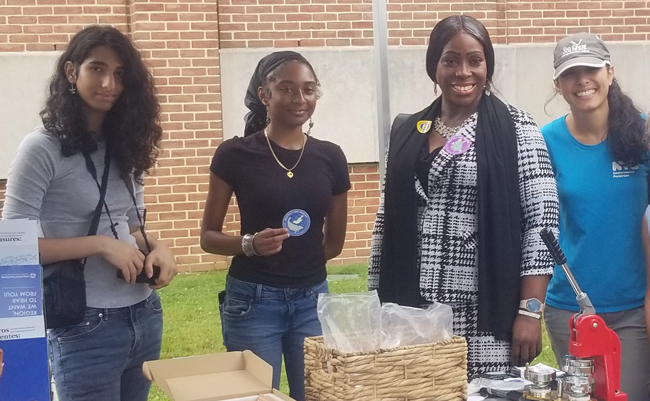
Crow Idnani (at left) worked with Columbia University Center for Sustainable Development’s Eco Ambassadors program, leading students from around the world through a course on microplastics pollution and training them in using mapping software like ArcGIS Apps (Esri).
Crow Idnani is a Fall 2025 senior at Cornell University, majoring in environmental science and minoring in both English and anthropology. As a summer CEI fellow, Crow spent his summer working with Eco Ambassadors, an online seminar series administered by Columbia University’s Center for Sustainable Development. Out of 417 applicants, 90 were accepted into the program.
“We have students from all over the world,” Crow said of his experience with the program. “We taught them all about the way civilizations develop, the way societies function. We taught them about institutions, we taught them about mapping software, and we gave them the tools needed to take what they've learned and turn it into something that they can use in their communities to make change.”
The goal of the program is to prepare the Eco Ambassadors to be able to control some of the impact on their own communities. Part of Crow’s role in the fellowship was to “take these very abstract and large-scale concepts and focus them using the context of microplastic pollution in the New York area around Long Island Sound.”
Part of the way that Crow helped break down these large concepts was through using publicly available ARCGIS maps provided by NOAA. “It's important for the students to understand how to localize things. That was my big role.”
Once Crow explains to the students what the markers on the map mean and how to read it — such as the squares showing microplastic pollution, higher concentrations of microplastics, or currents – he then talks with the students about what they understand and potential next steps to try to implement positive change.
“It becomes a discussion between us and them. Even if they don’t live in the New York area, they can still use it as a case study to take back home with them.” In fact, Crow cites that as his biggest takeaway from his internship experience: people take place with them. “We have students from all over the world, and not all of them relate to the New York area…but they can all take something that they learned [with Eco Ambassadors] back to their own locations, their individual context very much informed by what they brought to our discussions.”
Crow feels that the field of environmental science is so broad that he could go in many different directions — a lot can change in a year. While the rising senior is keeping his options open, he does have shorter term goals: presenting to his students on the importance of having an action item with their stories, and continuing to learn more about working with mapping software.
“I found that I really enjoy working with data, which I didn’t expect. It turns out that it’s very fun.”

Elise Ruby (pictured here in a bug net and sampling gear) spent her summer examining contaminants in fish from Buffalo, NY waters. She conducted field work with NYSG, the U.S. Fish and Wildlife Service (USFWS) Lower Great Lakes Fish and Wildlife Conservation Office, and the Razavi Ecotoxicology Lab, helping catch fish and prep them in the lab for contaminant analyses.
Elise Ruby is a Fall 2025 sophomore at SUNY ESF, where she is working on a degree in Environmental Biology. As a fellow studying Great Lakes fish contaminants, Elise worked closely with her mentor, Stacy Furgal (a NYSG Great Lakes Fisheries and Ecosystem Health Specialist) and Dr. Roxanne Razavi in the Razavi Environmental Toxicology Lab at SUNY College of Environmental Science and Forestry (SUNY ESF).
“?I got to work on a lot of different projects revolving around contaminant work. We mainly focused on mercury and PFAS (a synthetic chemical pollution) in aquatic ecosystems around New York state,” Elise shared about her experience.
As a fellow, her main project focused on comparing contaminants (like PFAS and mercury) and nutrient composition in both wild-caught and store-bought fish in Buffalo, New York. “We went out with partners from the U.S. Fish and Wildlife Service to electrofish for wild-caught fish from the upper Niagara River. Then we went out and purchased fish from five different local stores all around Buffalo.” Elise and others in the Razavi lab then worked to process the fish samples to prepare them for analysis.
Elise also assisted with the implementation of a three-day workshop hosted by NYSG and Cornell University, where representatives from government agencies and community organizations worked towards the goal of better aligning fishing regulations and consumption advisories.
As an additional part of the outreach portion of her internship, Elise also had the exciting opportunity to work on a podcast episode with Dr. Razavi (her mentor at ESF) for the podcast Water Bodies.
One of Elise’s biggest takeaways from her internship experience was learning that research isn’t always going to be perfect.
“Sometimes you come up with a plan and it doesn't always happen [as expected]. You have to do the best you can with it,” Elise explained, recounting how sometimes plans changed on the fly when out in the field. “That was a big thing for me [as someone with] very little research experience — participating in research and learning that just because you have a plan doesn't necessarily mean you're going to be able to execute it the way you had planned it.”
Looking to the future, Elise plans on wrapping up field work in the Adirondacks for another research project, finishing her podcast episode with Dr. Razavi, and working in the Ecotoxicology Lab this fall conducting lab work and — eventually — research.
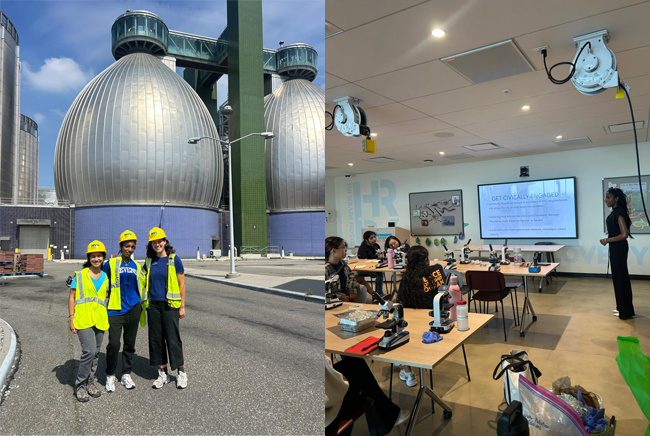
NYSG's Catherine Prunella (at far right), Genesis Dacosta (middle), and fellow 2025 CEI fellow Janice Yohannan (at far left) at the Newtown Creek Wastewater Treatment Facility in Brooklyn, NY. Genesis Dacosta explored solutions to microplastic pollution in fashion. She helped run workshops with Genspace and Hudson River Park and drafted a website to engage New Yorkers in environmental sustainability.
Genesis Dacosta is a Fall 2025 junior at The City University of New York’s John Jay College of Criminal Justice, where she is pursuing a major in political science. As part of her work for the summer CEI program, Genesis worked on studying the effects of fashion and microplastics with her mentor Catherine Prunella (a NYSG Water Quality Extension Specialist). This meant creating a number of deliverables, including her biggest project this year — drafting an entire website.
“The point of this website is, how can we get New Yorkers engaged in environmental sustainability? So I came up with the website Trash Free NYC, a website for New Yorkers to take action on recycling, composting, and cleanups.” Helping New Yorkers become civically involved in their communities is a big focus for Genesis, who wove that specific thought into her website draft. “It brings together textile waste, volunteer events, and contact information all in one place, and focuses on environmental justice across all the five boroughs.”
A big part of Genesis’ summer internship was spent co-administering microplastic workshops with Genspace and Hudson River Park. This involved working closely with interns to collect and analyze microplastic samples from the Hudson River.
“The students really enjoyed this workshop,” Genesis said. She explained a little more about how the process worked: “They identify microplastics under blue light. Essentially, [the sample] is supposed to glow a little bit, which shows that there’s microplastic there.”
Other workshops involved taking a piece of tape, putting it on students’ clothing, and ripping it off to collect microplastic to examine under the microscope. Genesis’ favorite workshop was the Hudson River Park Microplastic Workshop, where students were tasked with trying to find microplastics in store-bought shrimp, an assignment she says “they absolutely loved.”
Alongside creating a number of deliverables — social media posts demonstrating how to recycle unwanted textiles and how to use a filter in washing machines to prevent microplastics entering the water — Genesis led discussion groups with her students, helping them get civically engaged and educating them on microplastics in laundry.
There were a number of high points from Genesis’ fellowship, including the chance to visit a wastewater treatment plant and working on her public speaking skills. “[High schoolers are] really interested in learning more about microplastics. I learned how to facilitate meetings and, overall, how to make communication more accessible.”
She also changed how she purchases and washes her clothes after her experience. “I definitely check my clothing tags more often,” she said with a smile, “and I was able to convince my dad to get a laundry filter to filter microplastics.”
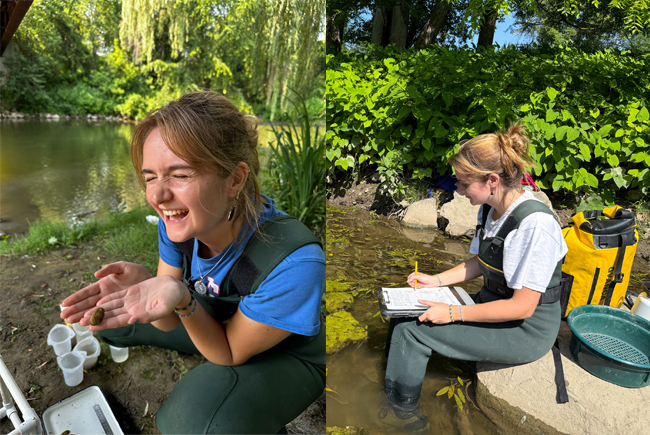
Isabel Hahl (pictured at left measuring mussels at Tonawanda Creek in Rapids, NY and at right doing stream surveys at Cayuga Creek) partnered with University at Buffalo researchers to investigate native freshwater mussel habitat feasibility. She also worked with NYSG Literacy Specialist Nate Drag to create a freshwater mussel lesson plan for local educators.
Isabel Hahl is a Fall 2025 junior at Colgate University studying biology and environmental studies. As a CEI intern based in the Great Lakes region, Isabel partnered with NYSG and University of Buffalo — under the guidance of her mentor, NYSG Great Lakes Literacy Specialist Nate Drag — to work on freshwater mussel research and education.
“On the community engagement side of my internship, I worked with local educators to connect [our work with mussels] to the school system to see if they can use it [in curriculum], such as by teaching about life cycles or about invasive species.”
Part of this program involved Isabel helping conduct a professional development workshop for teachers and educators. She explained that some species of mussels release larvae that attach to fish gills. After putting out a little lure that looks like a miniature fish, fish come and try to eat the smaller ‘fish,’ allowing mussel larvae to parasitically attach to them.
“For the workshop, we separated the teachers into mussels and fish, and had the different ‘mussels’ find their host ‘fish.’ If they could connect, the ‘fish’ would accept a small colored ball representing the larvae from the ‘mussel.’ We added a bunch of different aspects to it to demonstrate how intricate the whole system is.” By participating in this demonstration, the teachers not only gained knowledge of the life cycle of freshwater mussels but also gained the necessary experience and confidence with the activity to allow them to implement it with their students during the school year.
In addition to working with community members, including tabling to educate the public on the work University of Buffalo and NYSG has been doing, Isabel has also been busy with creating educational materials and conducting field work.
“Over the summer, one of my major [projects] was creating a field guide that students can use,” she explained. “This includes photos of mussels to help them develop observational skills in order to discover what type of mussel they’re looking at.” She hopes that this project will help students connect with where they live and inspire them to love science.
Isabel also spent the summer engaging in multiple important research projects: “For the mussels, we're looking at habitat feasibility, seeing if we can potentially reintroduce mussels into the Great Lakes tributaries in the future; we’ve looked to see if mussels can help digest E.coli at Woodlawn Beach; we've been looking at mussel propagation; I've been helping out with round goby invasion ecological system work; and I have gone on a couple field days to look at pesticide levels in the water.”
Despite how varied her work seems, Isabel found all of her experience invaluable, and says that it helped her better understand working on other research projects. “The whole system is pretty holistic, so it's been interesting to have experience with that.”
Looking forward to the future, Isbael is hoping to utilize the skills, knowledge, and connections she made during the CEI program to do some independent research and do field work in study abroad opportunities, including an upcoming one in Panama. She also plans to take the knowledge she learned from her research this summer and apply it in a way to inspire future generations to love science.
“What I'm going to take from this internship is a love for freshwater mussels that I didn't know I had before,” she said. “I really discovered that I love freshwater ecology.”
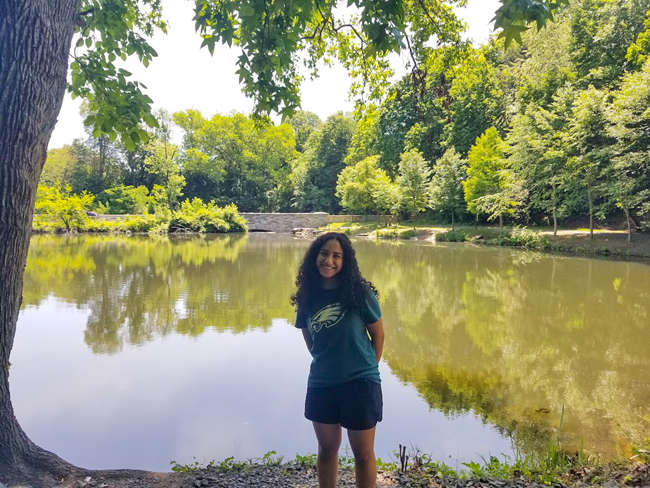
Janice Yohannan (pictured above at a herring monitoring site in Wilson Woods, Mount Vernon, NY) spent her summer as a Wetland Field Data Collection Fellow monitoring natural and nature-based features with the Natural Areas Conservancy. She will co-present her team's findings to the Urban Waters Federal Partnership (U.S. Environmental Protection Agency) this fall.
Janice Yohannan, a fall 2025 junior at Cornell University, working on a degree in environmental studies and earth science with a focus on land and water resources. As a 2025 NYSG CEI fellow, Janice worked with her mentor Lillit Genovesi (a NYSG Outreach Coordinator with the Long Island Sound Partnership), the Long Island Sound Partnership (LISP), and the Natural Area Conservancy, doing natural and nature-based features monitoring.
“I spent the first few weeks doing community events, but the bulk of my summer was spent doing natural and nature-based features monitoring (NNBF),” Janice said of her fellowship experience. “If you’re unfamiliar with the concept, we have more conventional methods of protecting shorelines that include more hard structures — sea walls, jetties, and things like that. But natural and nature-based features work into the local environment and promote biodiversity.”
This meant that Janice spent a lot of her summer internship working in wetlands, salt marshes, and other living shorelines, collecting data on these natural features and seeing how they can be used to improve environmental outcomes: “We [were] essentially assessing the health and impact of these features to identify resilience benefits.”
In-between conducting field work and analyzing protocols and parameters in ARCGIS (a geospatial mapping program), Janice and some other interns worked on a personal project — a feedback document on making their work and training more efficient — and she, alongside her mentor Lillit, helped conduct professional development sessions for New York City teachers. “I was able to assist [Lillit] in Sound Steward events, promoting environmental stewardship in elementary-aged students,” Janice explained, adding, “Education systems understand the need for hands-on training for exposure to local environments, because we did see a very broad understanding of their local environment. Just understanding that was pretty valuable to me.”
Beyond education and looking at areas that will be influenced by supporting natural and nature-based features like salt marshes, Janice also worked with the community by conducting social surveys to find out who is using these areas, their understanding of natural features, and issues with safety or accessibility.
While Janice reflects that one summer isn’t enough to fully understand the environmental needs and issues within the communities she was working with, she found the experience invaluable in helping her decide how she would like to apply her internship knowledge in the future. “It got me thinking about how when I pursue field work in the future, I could invest in these local sites outside of my job, outside of field work.” She also learned the importance of collaboration, especially in getting to network with a lot of different people and taking partners’ needs into consideration. “Something that I really realized was that if you know your network well enough and you have a problem, someone definitely has the answer. Learning to navigate my network was really important for me this summer.”
In the future, Janice thinks that she might want to explore law and policy, crediting her experience this summer for her new interest. “Being exposed to policy through working with the Department of State exposed me to the intersections between research and policy, which I really enjoyed. It is something that I want to pursue more.”

Miradyn Feist has been spending her time getting hands-on experience in workforce development and learning about Long Island’s oyster industry through Long Island Oyster Growers Association (LIOGA) and Hart’s Hatchery.
Miradyn Feist is a Fall 2025 junior at Cornell University, where she is working on a double major in both environment & sustainability and government. Miradyn spent her summer getting hands-on experience in workforce development and learning about Long Island’s oyster industry through the Long Island Oyster Grower’s Association (LIOGA) and Hart’s Hatchery under the guidance of her mentor, Barry Udelson (a NYSG Aqua Specialist).
“I came into this with absolutely zero understanding of any kind about oysters,” Miradyn shared about the beginning of her summer with the hatchery. “It’s really like a whole new world has opened. Now I can talk about oysters for twenty minutes nonstop without being interrupted. There’s all sorts of new stuff that I hadn’t even known about before.”
“You don't need a lot to have an oyster hatchery running, but there is a lot of work that goes into it,” Miradyn reflected, stating that it is a year-round process. As part of her duties at the hatchery, Miradyn helped out with both daily and weekly tasks, which alternated between performing plankton tows (skimming the water to check for phyto- and zooplankton), cleaning tanks and equipment, and grading the oysters, to name a few.
Her favorite task is a unique one: helping clean the oysters of parasites. “This is going to be a weird answer, but I really, really like cleaning the parasites [off the oyster broodstock (adults used for spawning)],” Miradyn shared with a grin. “It's really satisfying in a weird way — we dip them in bleach and all of these worms will crawl out of the oysters. It's disgusting, but I feel, in a weird way, like I'm taking care of my babies. Once they've been bleached and cleaned, the oysters are sparkling and pretty and they look ready to eat.”
Alongside her hatchery work, she also worked on updating the LIOGA website to make it more public-facing, and worked with the President, Eric Koepele, on improving community outreach.
“[The goal is to] make it that people who want to buy oysters locally are able to and understand that it's safe, it's healthy, and it helps the environment," Miradyn said. “That's been really rewarding, and in that process, I've been able to talk to some 60 different [oyster] farms all across Long Island to learn about their operations.”
Miradyn’s experience as a CEI fellow has done more than provide her with a warm, strong community network and practical experience — it has also influenced her future career path. While she originally considered focusing on law and policy related to open water fisheries, Miradyn is now thinking of possibly focusing on domestic production.
“Through talking to all those farms and Lizzie (a co-owner of Hart’s Hatchery), there's so many environmental issues that could be addressed with good, strong science-backed legislation,” Miradyn says.
She has already been studying law and policy, and credits both shadowing a pivotal member of the aquaculture industry and gaining hands-on experience with helping her decide her next steps.
“In general, good policy comes from good science. I think that writing policy, writing legislation, and addressing the environment without having actual experience is not possible. So being able to say: ‘I worked at a hatchery. I know what the issues are. I know that they're facing algal blooms. I know that [warmer waters are] affecting their spawning…’ Being able to have that insight is going to be really helpful.”

Veda Keon conducted research on microplastic pollution in the Hudson River and assisted in education programs with the NYS Department of Environmental Conservation, including the 2025 Institute Discovering Environmental Scientists (TIDES) program.
Veda Keon is a Fall 2025 junior at SUNY College of Environmental Science and Forestry (ESF), where she is studying conservation biology with a minor in marine science and environmental writing and rhetoric. As a CEI fellow, she spent the summer conducting research on microplastic pollution in the Hudson River.
“My research project this summer was comparing microplastic concentrations throughout the water column in the freshwater versus brackish water of the Hudson River,” Veda said, speaking on her experience. “I tested microplastic concentrations here at Norrie Point and then also down in Yonkers, and then compared those to see their results.”
She pointed out that while overall microplastic concentrations in water are becoming more common knowledge, she was specifically researching a different question — whether the concentration of microplastics are evenly distributed vertically through the column.
As part of this project, Veda created some outreach documents. One compared microplastics to the number of fish in the river, “as opposed to liters of water, which is how it’s normally compared… I figured fish would be a little more digestible for people who don’t commonly work with [measurements like] per liter of water, and it is a more tangible measurement for them.”
Veda also spent her summer helping out with a large number of educational programs for local studies, including The Education And Microplastics Science Community River Assessment Project (TEAM SCRAP), a community based program that collects and analyzes microplastic samples, and the 2025 Institute Discovering Environmental Scientists (TIDES), a paid research program for high schoolers.
“The community I was working with was primarily high school students; some of them had some science knowledge, some of them didn't,” Veda explained. “So a big thing that I learned this summer was that I had to really tailor how I was talking to who I was talking to, because not everybody has the same knowledge base that I do when it comes to science.”
She gave a specific example of this happening in the field. “The project I was helping with [in the TIDES] was looking at diversity in the streams. There was one student that I was helping do a Shannon's Diversity Index, and then I realized he might not know why we're doing this, because I didn't learn that until college. I helped explain it to him, but it made me realize that not everybody knows everything that I do. That was one of my real big takeaways from this.”
Reflecting on the fellowship, Veda feels that it was a really cool experience to have.
“I feel like I’ve made a lot of really good connections here, which I think will be good in the future,” she said. She also added: “I don’t normally work a lot with non-science people, so it was a nice thing to do this summer, learn[ing] how to communicate better with people. I feel like that's a big thing we need in science.”
More Info: New York Sea Grant
Established in 1966, the National Oceanic and Atmospheric Administration (NOAA)’s National Sea Grant College Program promotes the informed stewardship of coastal resources in 34 joint federal/state university-based programs in every U.S. coastal state (marine and Great Lakes) and Puerto Rico. The Sea Grant model has also inspired similar projects in the Pacific region, Korea and Indonesia.
Since 1971, New York Sea Grant (NYSG) has represented a statewide network of integrated research, education and extension services promoting coastal community economic vitality, environmental sustainability and citizen awareness and understanding about the State’s marine and Great Lakes resources.
NYSG historically leverages on average a 3 to 6-fold return on each invested federal dollar, annually. We benefit from this, as these resources are invested in Sea Grant staff and their work in communities right here in New York.
Through NYSG’s efforts, the combined talents of university scientists and extension specialists help develop and transfer science-based information to many coastal user groups—businesses and industries, federal, state and local government decision-makers and agency managers, educators, the media and the interested public.
New York Sea Grant, one of the largest of the state Sea Grant programs, is a cooperative program of the State University of New York (SUNY) and Cornell University. The program maintains Great Lakes offices at Cornell University, SUNY Buffalo, Rochester Institute of Technology, SUNY Oswego, the Wayne County Cooperative Extension office in Newark, and in Watertown. In the State's marine waters, NYSG has offices at Stony Brook University and with Cornell Cooperative Extension of Nassau County on Long Island, in Queens, at Brooklyn College, with Cornell Cooperative Extension in NYC, in Bronx, with Cornell Cooperative Extension of Ulster County in Kingston, and with Cornell Cooperative Extension of Westchester County in Elmsford.
For updates on Sea Grant activities: www.nyseagrant.org, follow us on social media (Facebook, Twitter/X, Instagram, Bluesky, LinkedIn, and YouTube). NYSG offers a free e-list sign up via www.nyseagrant.org/nycoastlines for its flagship publication, NY Coastlines/Currents, which it publishes 2-3 times a year.